Capabilities
- Progression engine
- Barcode scanner
- iOS app
- JWT authentication
Frontend
 Angular
 Ionic
 Capacitor
 TypeScript
Backend
 NestJS
 Node.js
 PostgreSQL
 Neon
 Vercel
fit
In Progressfit started as a replacement for the spreadsheet my coach planned my training with: routines, weekly loads, diet options, supplements and body measurements. It logs every set with weight, reps and RIR, and a double-progression engine tells you when to add weight or reps and flags plateaus. Nutrition comes with search, reusable meal blocks and a barcode scanner backed by Open Food Facts. A NestJS API with TypeORM and PostgreSQL, and an Angular and Ionic app with Capacitor for iOS, built working with AI agents.
The challenge
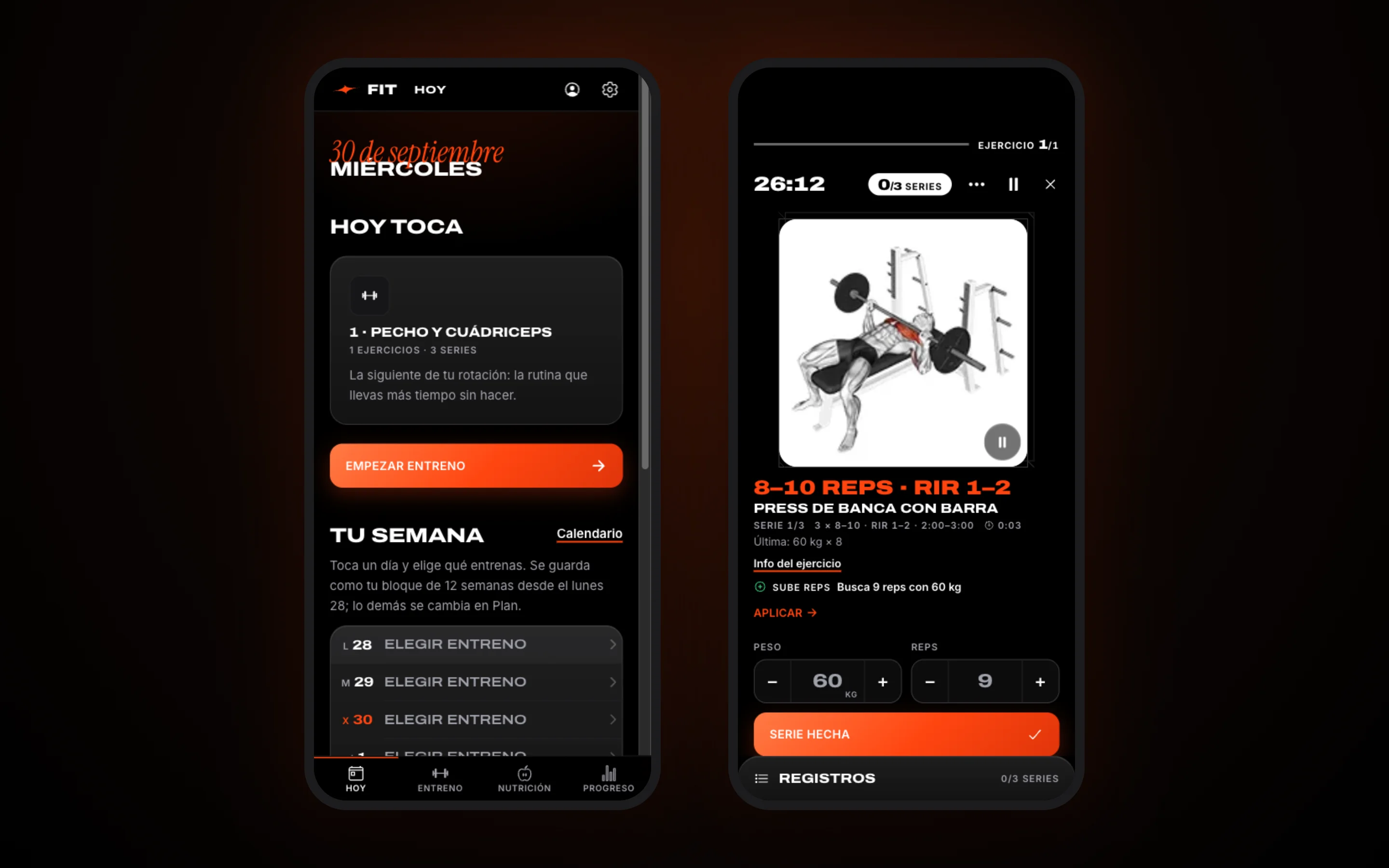
At the gym your phone is in one hand and there is little time between sets. The challenge was to make logging a set a single gesture, have the app know what's on today and with what weight, and make the scanner work in iPhone Safari too, which doesn't ship the browser's barcode reader.
Screenshots
Desktop 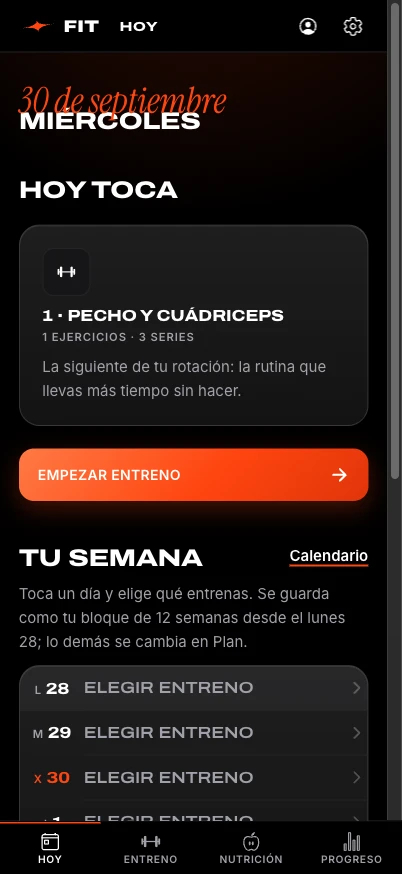
Mobile
Implementation
Double-progression engine
Pure, tested rules that decide whether to add weight or reps, detect plateaus, regressions and suspicious jumps, and account for warm-ups, drop sets and micro-loading.
Block planning
12-week mesocycles with a weekly split and a strip of done, skipped and pending days, or an automatic rotation: the Today screen tells you which routine is next.
A scanner in any browser
It uses the browser's BarcodeDetector where it exists and, where it doesn't (Safari and Chrome on iPhone, Firefox), reads with ZXing in WebAssembly. In the iOS app, a custom native plugin in Swift. It also reads GS1 QR and DataMatrix codes.
A session built for one hand
Optimistic saving with retries, swipe to mark a set as done and a rest countdown that opens the next set by itself when it ends.
An AI coach with context
fit-claudio, an AI agent with a coach's rules, reviews the routines and leaves comments on each one, asks questions every few weeks and answers the photo notes left during a workout.
Built vertically, with tests
Each module is built end to end, from the database to the screen, with unit and end-to-end tests on the back end and a browser check before it is called done.